IT company · Software · Cloud · Integration
Poto Gastro
Hamburg GmbH
We design, build and maintain software systems — from web applications to cloud infrastructure and the integrations that connect them.

Illustrative image
01Introduction
Despite the name, we are a technology company. Our work is writing software, shaping its architecture and keeping it dependable after launch.
02Core capabilities
Software
Custom applications shaped around specific business processes.
Web
Browser-based products, portals and internal tools.
Cloud
Infrastructure, deployment pipelines and operations.
Integration
APIs and connections between existing systems.
Quality
Testing strategies that match the risk of each change.
Support
Maintenance, updates and incremental improvement.
03Custom software development
Software built for how you actually work.
Off-the-shelf products cover common needs. When a process is specific to your organisation, custom software can model it directly instead of forcing workarounds.
We begin with the domain: the data, the rules and the people involved. Architecture follows from that understanding, not the other way round.
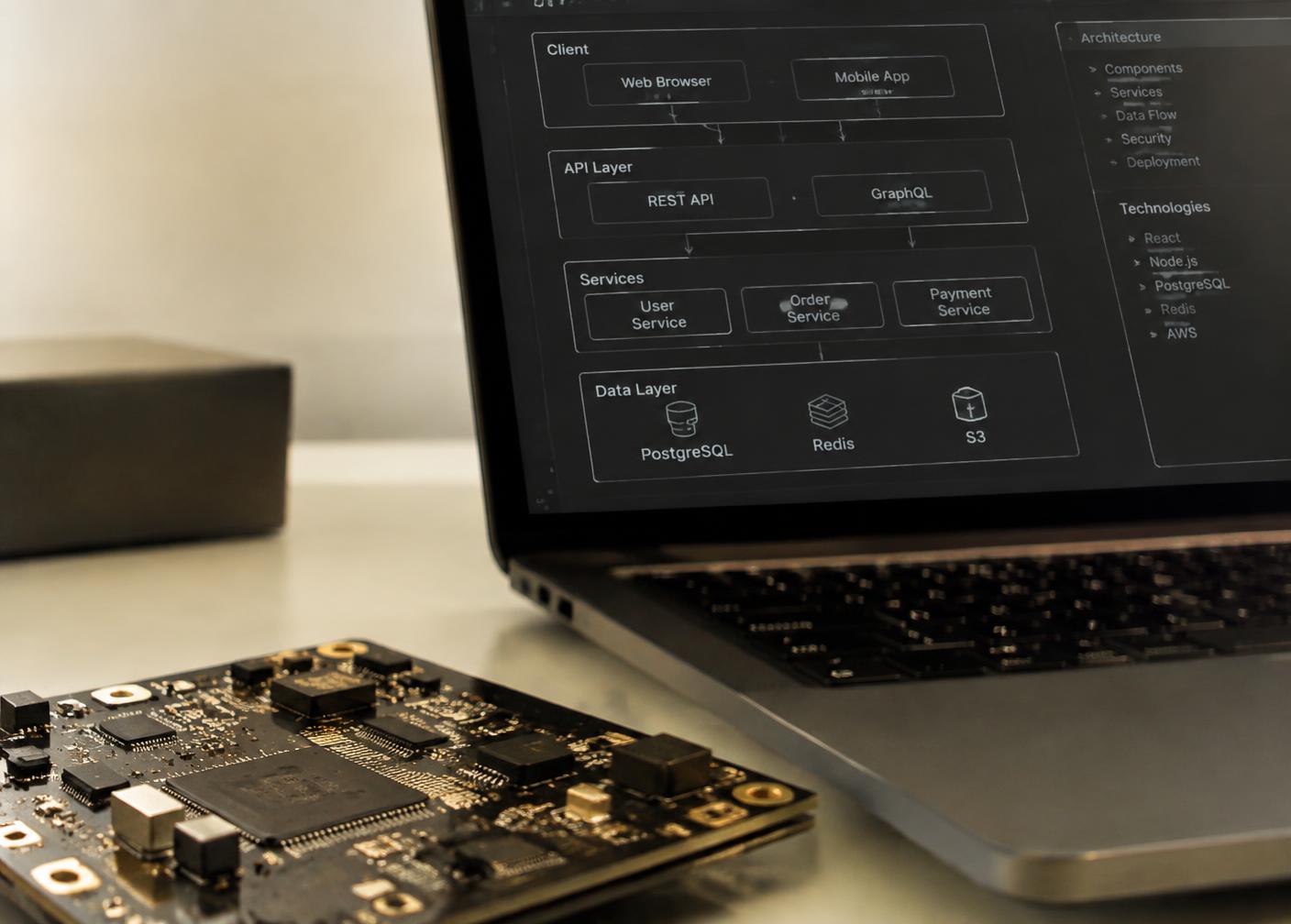
04Web application engineering
Fast, accessible, maintainable web products.
Interfaces
Responsive layouts, keyboard support and semantic markup as defaults, not extras.
Performance
Attention to load time, rendering cost and the networks real users are on.
Backends
Server logic, data models and authentication designed for clarity.
Evolution
Codebases structured so new features do not require rewrites.
05Cloud and infrastructure
Infrastructure you can reason about.
We work with infrastructure as code, reproducible environments and automated deployment pipelines so that changes are reviewable and reversible.
Monitoring, logging and sensible alerting are part of the setup, giving teams visibility into how systems behave in production.

06Systems integration
Connecting the systems you already depend on.
01
Map
Document data flows, ownership and failure points between existing systems.
02
Connect
Build APIs, adapters and event pipelines with clear contracts and versioning.
03
Observe
Add retries, idempotency and tracing so integrations fail visibly, not silently.
07 · Quality assurance and testing
Testing proportional to risk.
Not every line needs the same scrutiny. We focus automated tests on business rules, integrations and paths where failure is costly.
Unit, integration and end-to-end tests are combined with code review and manual exploratory testing where it adds value.
08Security-conscious engineering
Security as a habit, not a phase.
- →Least-privilege access for services, people and credentials
- →Secrets kept out of source code and rotated when needed
- →Dependencies reviewed and updated on a regular schedule
- →Input validation and output encoding at system boundaries
- →Sensitive data minimised, and encrypted in transit and at rest
09Delivery process
1
Discover
Clarify goals, constraints and what success looks like.
2
Shape
Agree on architecture, scope and first increment.
3
Build
Deliver in short cycles with working software to review.
4
Release
Deploy with automation, monitoring and rollback paths.
5
Sustain
Maintain, measure and improve after launch.
10Collaboration principles
Shared visibility
Progress, decisions and open questions are written down where everyone can see them.
Plain language
We explain technical trade-offs in terms of cost, risk and time, not jargon.
Honest estimates
Estimates come with their assumptions and are revised when those assumptions change.
Your ownership
Code, documentation and infrastructure access remain with you.

11Maintainability and long-term support
Software outlives its launch.
Most of a system's life happens after release. We write readable code, keep documentation close to it, and offer ongoing support for updates, security patches and gradual improvements.
12Illustrative project scenarios
Examples of work we can take on.
These are hypothetical examples to illustrate typical engagements. They do not describe real clients or completed projects.
Example A · Hypothetical
Replacing spreadsheets
A team tracks orders across shared spreadsheets. A small web application with roles, validation and an audit trail replaces manual reconciliation.
Example B · Hypothetical
Cloud migration
An application runs on a single aging server. It is containerised, moved to managed cloud services and deployed through an automated pipeline.
Example C · Hypothetical
Connecting systems
An accounting tool and an online shop do not share data. An integration service syncs records, handles failures and logs every exchange.
13Questions
Frequently asked.
- What kind of work does Poto Gastro Hamburg GmbH do?
- We are an IT company focused on software engineering: custom applications, web platforms, cloud and DevOps work, API development, systems integration, quality assurance and ongoing maintenance.
- Why does the company name mention gastro?
- The name is the registered company name. Our work is software and technology services; we do not operate restaurants or hospitality businesses.
- Can you take over an existing codebase?
- Often, yes. We usually start with a review of the code, infrastructure and documentation, so both sides understand its condition before agreeing on next steps.
- Do you work with fixed scope or iteratively?
- Both are possible. For well-understood work a defined scope can make sense; for evolving products we generally recommend short, reviewable increments.
- Which technologies do you use?
- We choose tools based on the problem, the existing environment and the people who will maintain the system later, rather than defaulting to a single stack.
- How do we start a conversation?
- Write to [email protected] with a short description of your situation. The contact page lists what is useful to include.